


A letter arrives in Kotor addressed simply to Stari Grad and a three-digit number. Somewhere behind the walls is the door it belongs to. There is no street name on the envelope to lead the way. For someone who knows the Old Town, however, the number exists inside another map altogether — one built through familiarity, buildings, households and names.
There is something increasingly unfamiliar about that. Most cities now require very little of our attention. A blue dot tells us where we are; a numbered building tells us when to stop. We can cross neighbourhoods whose names we never learn and arrive at a door without speaking to anyone along the way. Kotor does not exist outside that modern world, of course, but within its medieval walls there are still traces of an older relationship between people and place, one in which knowing where something was could also mean knowing who was there.
Understanding this changes the way Kotor is walked. What first appears to be a confusing medieval layout begins to read differently once you realise that orientation here was never entirely a matter of streets and numbers. The point is not to abandon the map or turn getting lost into a romantic travel ritual. It is to notice what the map leaves out: the human knowledge that once helped make the town legible, and the traces of it that remain.
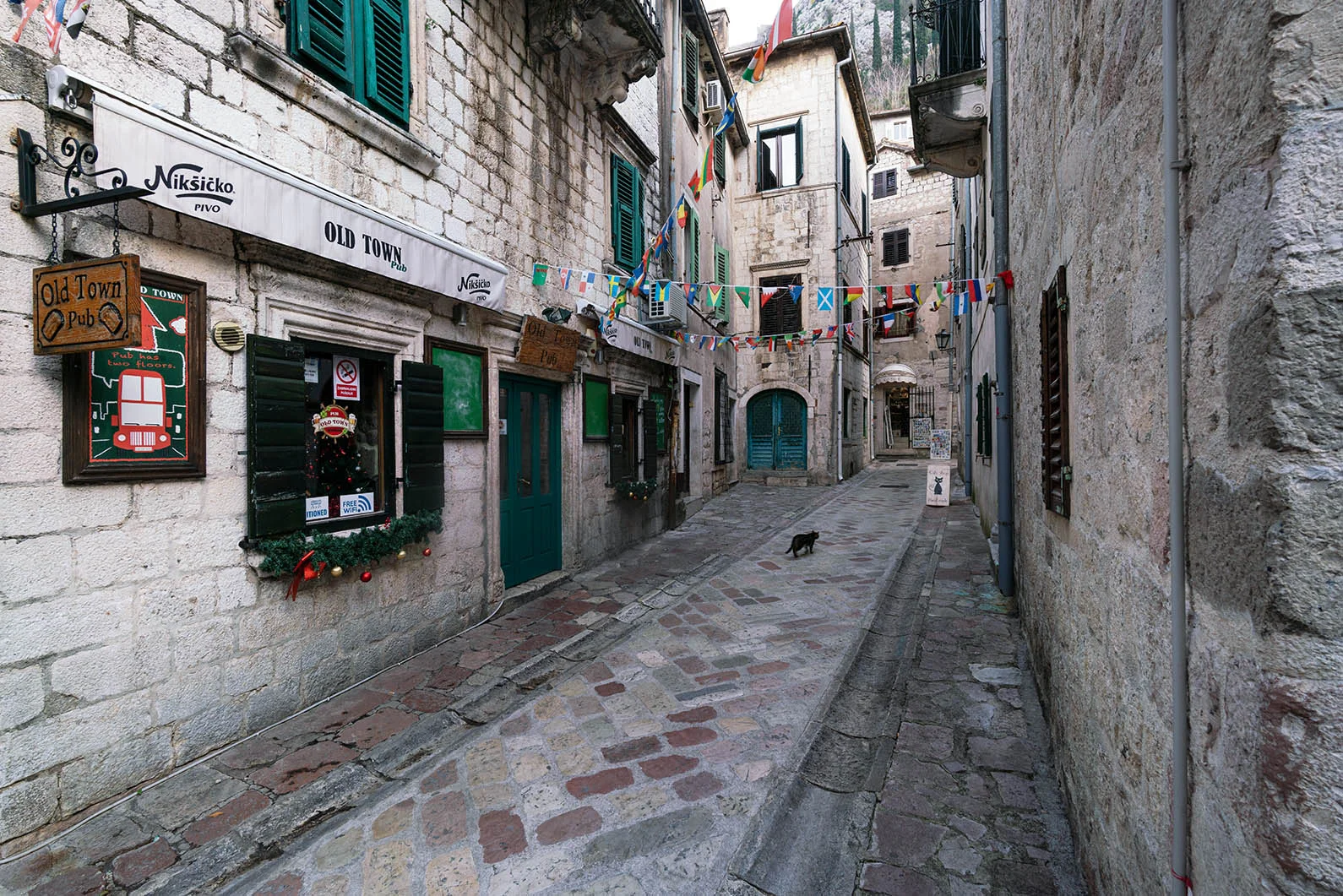
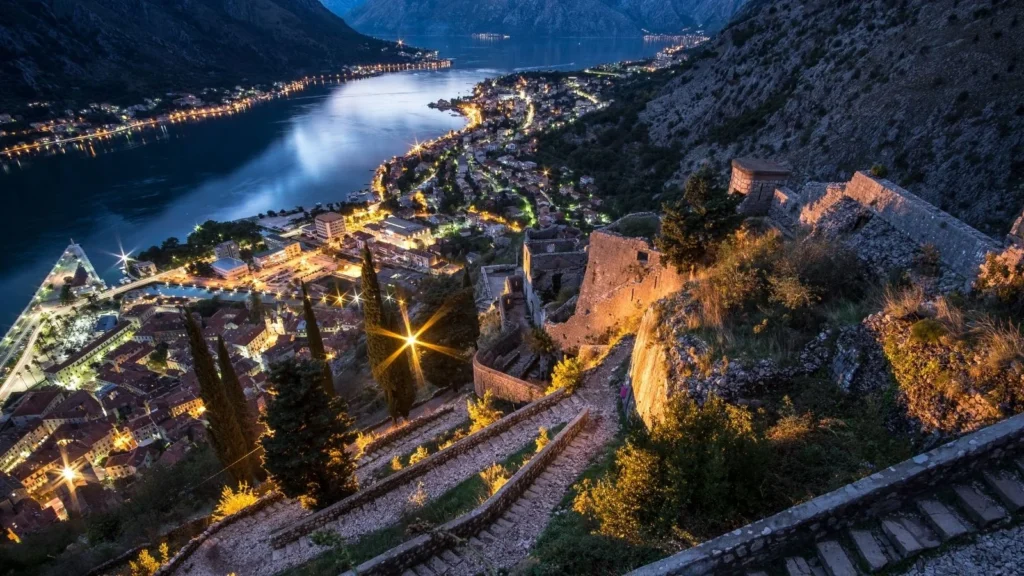
The physical town begins to explain why that knowledge mattered. Kotor’s walled Stari Grad, part of the UNESCO-listed Natural and Culturo-Historical Region of Kotor, grew over centuries rather than according to a modern urban grid. Its present character bears particularly strong traces of the centuries when the Bay was under Venetian rule: stone houses pressed closely together, passages changing width within a few metres, small squares appearing unexpectedly between churches, palaces and residential buildings. Lanes turn, narrow and reconnect; one passage can resemble another until a doorway, a church or a familiar corner gives it identity.
Addresses inside the walls reflect that geography in an unusual way. Buildings are identified within Stari Grad by numbers rather than by the familiar combination of a formally named street and a building number. An address such as Stari Grad 382 identifies a property administratively, yet gives an unfamiliar visitor remarkably little sense of where, among the interconnected lanes of the Old Town, number 382 might actually be.
For the people who lived here, that ambiguity was less problematic than it appears from outside. Numbers belonged to the formal system; everyday knowledge supplied the rest. Family surnames on doors and buzzers added another point of recognition, while churches, wells, squares, shops and households became part of the town’s practical vocabulary of location. Postal workers could work with numbers, but local orientation accumulated through familiarity. Knowing the town meant carrying a mental map that contained not only buildings, but associations.
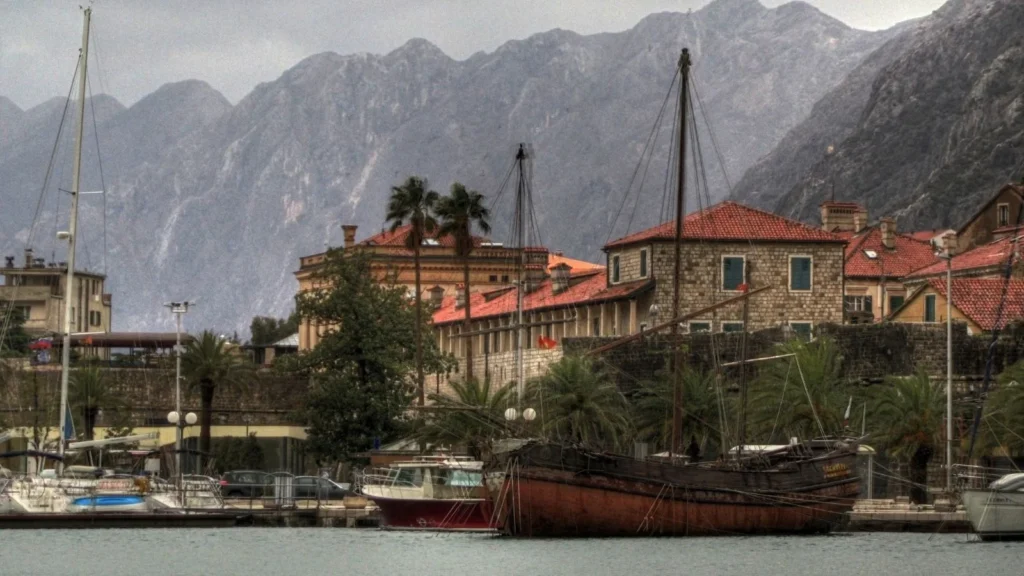
Even the lanes acquired another geography through use. Names such as Pusti Me Proć — approximately, “Let Me Pass” — describe the experience of squeezing through one of the Old Town’s particularly narrow passages. Zanatska, associated with craftsmen, preserves the memory of work once concentrated there; Mokra, or “Wet,” turns a physical characteristic into an identifier. These locally used names are interesting precisely because they show how a city can become legible below the level of official cartography. People name what they repeatedly encounter, and eventually those names become useful because others know what they mean.
Kotor carries the same relationship between name and place at a grander scale. Palaces including Pima, Beskuća and Bizanti continue to be identified through the families historically associated with them. Their surnames have become part of the architectural vocabulary of the town. A visitor can admire a façade without knowing any of this, but the building becomes something different once its name is understood not simply as the title of a monument, but as the residue of a family’s presence.
This is where Kotor becomes more interesting than the picturesque medieval city presented in travel imagery. Its stone walls are immediately legible as heritage; the social systems once operating within them are much easier to overlook. For the Bokelji, the people of the wider Bay of Kotor, relationships between family, settlement and local identity have long histories. A house could be understood through whose it was, a corner through what happened there, a passage through the work or physical condition associated with it. Geography accumulated biography.
But this is not a system frozen in time. Tourism, short-term rentals and changing ownership have altered who actually lives behind some of Kotor’s old doors. A family name may remain associated with a building long after the household that gave it meaning has gone. It is an important distinction in a town whose physical heritage is so visibly preserved: architecture and the culture that once animated it do not necessarily survive at the same pace. Stone can be restored. The knowledge of who lived behind it survives only for as long as someone continues to carry it.
What time gives us instead is the ability to notice the systems beneath the scenery.
For the slow traveler, this changes what is worth paying attention to in Kotor. Getting lost in Stari Grad is hardly a rare or profound experience; the layout makes it remarkably easy. What matters is what becomes visible once you understand why conventional addresses tell only part of the story. Ask someone where something is and notice what enters the answer. Look at the surnames beside residential doors, then at the historic family names preserved on palaces. Notice the informal names attached to passages, and the landmarks that make one corner distinguishable from another. Pay attention, too, to the difference between lanes that still feel inhabited and those whose ground floors now speak almost entirely to visitors.
None of this requires rejecting digital maps or pretending to participate in a local history that is not ours. Slow travel does not require us to perform the past. What time gives us instead is the ability to notice the systems beneath the scenery. We stop asking only What should we see? and begin asking How does this place actually work? In Kotor, that second question leads beyond architecture and into the accumulated knowledge that once allowed a town to be navigated as much through recognition as through information.
There is a kind of quiet luxury in that depth, although not the sort that can be booked. It is not the inconvenience of an unusual address, nor the romance of getting lost. It is the richness of continuity: of living somewhere long enough for households, landmarks, names and routes to become part of a shared vocabulary, until the environment is familiar beyond what any formal address needs to explain.
A visitor cannot acquire that belonging in a few days, and pretending otherwise would diminish it. We can only encounter its traces. But perhaps that is precisely what makes Kotor worth reading slowly. Its walls preserve the visible city extraordinarily well; its numbers preserve administrative locations; maps can record every passage with increasing accuracy. None of them, on their own, can preserve the knowledge that a particular door was once understood because people knew the family behind it.
That requires someone to remember.