



For years, slow travel has offered an appealing alternative to the exhausting pace of conventional tourism. Instead of moving through several cities in a week, travelers are encouraged to remain in one place, explore beyond the obvious attractions, and develop a more meaningful relationship with their surroundings. The promise is simple: fewer destinations, deeper experiences, and a less demanding way of seeing the world.
But as slow travel becomes increasingly popular, an uncomfortable question is emerging. What happens when thousands of travelers begin looking for the same quiet villages, independent guesthouses, and supposedly undiscovered corners of the world?
A small town does not necessarily remain quiet once it becomes widely recognized as the ideal place to escape crowds. A neighborhood valued for its ordinary rhythms may gradually find those rhythms reorganized around visitors. Even the search for authenticity can become a commercial force, transforming everyday places into experiences designed for outsiders.
The problem is not that slow travel has become undesirable. It is that its growing popularity exposes a contradiction within the idea itself: traveling more slowly does not automatically mean traveling with less impact.
When the Alternative Becomes the Trend
Slow travel is no longer a marginal preference associated with a small group of independent travelers. It has entered mainstream tourism marketing, where smaller destinations, longer stays, local experiences, and unhurried itineraries are increasingly presented as desirable alternatives to crowded landmarks and conventional sightseeing.
KAYAK’s 2026 travel trends report identifies a growing preference for smaller cities and rural destinations among younger travelers. Its research also points to relaxation, mental recovery, and a slower pace as important motivations for travel. Meanwhile, the OECD’s Tourism Trends and Policies 2026 recognizes the potential of slower and more locally connected tourism while emphasizing the need to distribute visitor flows and protect destination communities.
These developments reflect a genuine change in what many travelers want. After years of increasingly optimized itineraries, the attraction of remaining somewhere long enough to develop familiarity is understandable. Travelers may prefer a neighborhood café to another famous attraction, a regional train journey to another airport transfer, or several days in one town rather than a hurried sequence of destinations.
Yet the tourism industry is exceptionally good at turning preferences into products. Once a particular style of travel becomes fashionable, accommodation providers, booking platforms, destination marketers, and social media creators begin identifying places that fit its visual and emotional appeal. The quiet village becomes a recommended escape. The family-run guesthouse becomes a sought-after experience. The local market becomes an attraction.
None of these changes is necessarily harmful. Tourism can support businesses, preserve buildings, and create employment in places that need economic opportunities. But popularity also introduces pressures that were absent when a destination received relatively few visitors. The question is whether the infrastructure, housing market, environment, and local community can accommodate the attention being directed toward them.
The Limits of a Quieter Destination
One of the most common responses to over tourism is to encourage travelers to visit lesser-known places. The reasoning is understandable: if major destinations are overwhelmed, directing some demand elsewhere may relieve pressure while sharing tourism revenue more widely.
This approach can work, particularly when destinations have appropriate transport connections, accommodation capacity, and local support for tourism development. But lesser-known does not necessarily mean better equipped.
A small town may have fewer hotel rooms, limited public transportation, and public spaces designed primarily for residents. Its historic center may be physically incapable of accommodating large numbers of visitors without changing how people move through it. Restaurants and shops that serve the local population may face growing incentives to adapt their prices, opening hours, and offerings to tourist demand.
Consider the difference between an established tourism city and a small village receiving sudden international attention. The city may already have visitor-management systems, substantial accommodation capacity, and transport networks capable of absorbing considerable demand, even if some districts remain severely overcrowded. The village may have none of those advantages. A relatively modest increase in arrivals can therefore have a disproportionate effect.
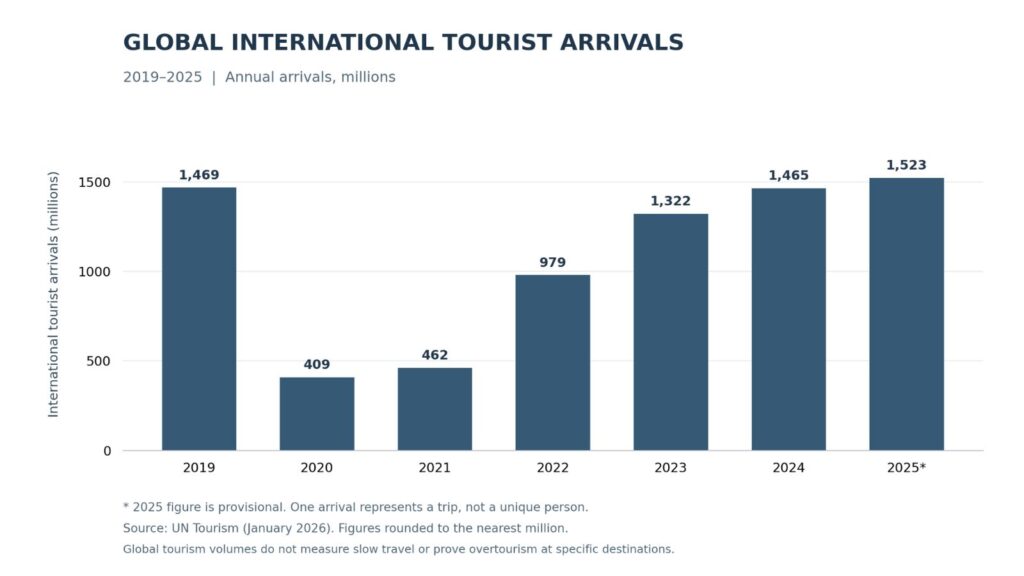
This is why redistributing tourists is not the same as managing tourism. Moving demand from one place to another may change the geography of the problem without addressing its underlying causes.
The distinction matters for slow travel because many of the places associated with its appeal are valued precisely for their modest scale, local character, and relative absence of tourism infrastructure.
Does Staying Longer Make Travel More Responsible?
Longer stays are often presented as a more sustainable alternative to frequent movement. There is a reasonable argument behind this approach. Remaining in one destination can reduce repeated transfers, encourage the use of local services, and create opportunities for spending beyond the most visible tourist businesses.
A traveler who stays for a week may become familiar with a neighborhood, return to the same restaurants, and explore places that would be overlooked during a brief visit. However, duration alone is a poor measure of responsibility.
A longer stay still requires accommodation, water, energy, transport, and other resources. Its effects depend on where the traveler stays, how the property operates, how the visitor moves around, and how tourism revenue circulates through the community.
There is also a difference between reducing the number of journeys and extending the length of a single trip. A traveler who replaces several separate flights with one longer journey may reduce some transport impacts. But simply adding days to a trip does not automatically reduce its total environmental footprint.
The same distinction applies to local economic benefits. Staying in a privately operated guesthouse does not guarantee that the property is locally owned or that its earnings remain in the destination. Dining in an attractive neighborhood restaurant does not necessarily reveal whether the business is financially accessible to residents or whether tourism has changed the surrounding commercial environment.
These considerations do not invalidate longer stays. They demonstrate why responsible travel must be evaluated through actual behavior and local conditions rather than the number of nights on a booking confirmation. Slow travel can create opportunities for a more considered relationship with a destination. Whether those opportunities produce better outcomes is a separate question.
The Complicated Search for Authenticity
Perhaps the most revealing tension lies in the language used to promote slow travel. Travelers are often encouraged to seek authentic neighborhoods, traditional villages, local rituals, and places untouched by mass tourism. The intention may be sincere: to experience a destination beyond the familiar attractions and standardized services of the international travel industry.
But authenticity becomes complicated when everyday life is treated as something visitors are entitled to discover. A residential street is not necessarily a cultural attraction simply because it looks picturesque. A traditional market may be an essential part of local commerce rather than a setting designed for photographs. A neighborhood gathering place may be meaningful because of the relationships among the people who use it, not because it offers visitors a particularly memorable atmosphere. When these spaces become widely promoted, their ordinary functions can come under pressure.
The issue is not that travelers should avoid local places altogether. Cultural exchange, independent commerce, and curiosity are legitimate parts of travel. The problem emerges when the visitor’s desire for an authentic experience becomes more important than the community’s ability to continue living normally.
A place does not become more authentic because tourists find it charming. Nor does its value depend on remaining undiscovered. The more useful question is whether tourism allows the local culture to continue on its own terms.
What Residents Experience Differently
Travelers and residents encounter the same destination from very different positions. For a visitor, a narrow historic street may offer an intimate atmosphere. For a resident, it may be the daily route to work or home. A lively café may feel like evidence of a thriving neighborhood to someone spending a few days there, while a longtime resident may see it as part of a broader change in local prices and businesses. These experiences can coexist without either being entirely wrong.
A 2026 study published in Humanities and Social Sciences Communications, examining tourism pressures in Vietnamese heritage towns and coastal destinations, draws attention to a particularly important imbalance. Tourists enjoy considerable freedom to move between places, while residents remain responsible for living with the economic, environmental, and social consequences of tourism development.
This perspective complicates the romantic idea of immersion. A traveler may feel deeply connected to a place after several unhurried days, but that personal connection does not establish whether tourism is beneficial to the people who live there. It also challenges the assumption that a friendly encounter or locally purchased meal is sufficient evidence of responsible travel.
Meaningful tourism must consider who benefits, who bears the costs, and who has influence over how the destination develops. Those questions are less visually appealing than photographs of quiet streets and beautiful guesthouses. They are also more important.
Slow Travel Is a Method, Not a Guarantee
None of this means that travelers should abandon slow travel in favor of conventional tourism. The movement still offers a valuable challenge to the idea that a successful trip is measured by the number of destinations visited or attractions completed.
Its strengths are real. A slower itinerary can reduce unnecessary movement, create time for cultural understanding, and allow visitors to engage with a destination beyond its most heavily promoted features. But these benefits should not be confused with automatic ethical superiority.
A hurried traveler can make thoughtful decisions about transport, accommodation, and local businesses. A slow traveler can contribute to housing pressure, environmental damage, or the commercialization of residential neighborhoods. The pace of a journey does not determine its consequences on its own.
This distinction is especially important as the travel industry increasingly uses words such as slow, authentic, immersive, and sustainable to describe products that may differ little from conventional tourism.
A longer booking is not proof of cultural engagement. A rural location is not proof of sustainability. A beautifully restored building is not proof that local residents benefit from its commercial use. The value of slow travel depends on the choices made within it.
What a More Thoughtful Approach Looks Like
If slow travel is to remain a meaningful alternative, its definition needs to extend beyond personal enjoyment.
Destination selection should consider more than beauty, atmosphere, and the absence of crowds. It should also account for accessibility, visitor infrastructure, environmental sensitivity, and the capacity of local communities to accommodate tourism.
The timing of a visit matters. Traveling outside peak periods may help distribute demand, although seasonal conditions and local circumstances need to be considered rather than assuming that every quiet month is suitable for visitors.
Accommodation choices matter as well. Independent properties can offer a stronger connection to local culture, but their ownership, employment practices, relationship with the neighborhood, and use of existing buildings deserve attention.
Perhaps most importantly, travelers need to recognize that not every appealing place requires greater exposure. A neighborhood does not need to become an international recommendation to be culturally significant. Some environments are best understood through their existing public spaces and established visitor opportunities rather than through attempts to access every corner of local life.
This does not require travelers to become experts in tourism policy before booking a holiday. It requires a change in the questions they ask. Instead of considering only whether a destination offers the atmosphere they want, they can also ask whether their presence fits the place they intend to visit.
The Future of Slow Travel Depends on More Than Slowing Down
The current popularity of slow travel presents both an opportunity and a warning. It suggests that travelers are increasingly questioning the value of constant movement and recognizing that memorable journeys do not require an exhausting itinerary. That is a welcome development.
At the same time, the commercial success of slow travel risks reproducing some of the pressures it was supposed to challenge. Smaller destinations can become fashionable, local experiences can become standardized, and the language of meaningful travel can be used to sell an experience without examining its consequences.
The answer is not to keep searching for quieter places until every quiet place becomes popular. Nor is it to assume that staying longer automatically makes a traveler more responsible.
Slow travel becomes genuinely different when it changes not only the pace of a journey, but the relationship between the visitor and the destination. That relationship requires curiosity, restraint, and an awareness that the places we admire are not simply settings for our experiences. They are communities with their own needs, priorities, and futures.
The real measure of slow travel is not how little a traveler does, but how thoughtfully they travel—and what their presence means for the place they leave behind.