



There is a persistent belief that slow travel belongs at one of two extremes. It is often imagined either as a lifestyle reserved for wealthy travelers with unlimited time, or as a way of traveling adopted by those willing to sacrifice comfort in exchange for lower costs. Between those two assumptions, many people quietly conclude that slow travel simply does not apply to them. The reality is considerably more interesting.
Slow travel is not defined by how much money someone spends. It is defined by the relationship between time, movement, and intention. A traveler staying six weeks in a restored farmhouse in Provence, a couple renting a contemporary apartment in Tokyo for a month, and a remote worker living quietly in northern Thailand may have entirely different budgets, yet all are practicing the same philosophy. Their financial circumstances differ. Their pace does not.
This distinction matters because discussions about slow travel often begin with prices when they should begin with structure. The question is rarely whether slow travel is expensive or inexpensive. The more useful question is how the financial structure of a journey changes once movement stops becoming the centre of the experience.
Traditional travel is built around transitions. Flights, airport transfers, hotel check-ins, train reservations, rental cars, luggage storage, and short stays all create repeated financial friction. Each movement introduces another layer of cost, often accompanied by decisions made under time pressure rather than thoughtful planning. Much of what travelers spend is not directed toward living in a place but toward reaching the next one.
Slow travel quietly rearranges that equation.

Instead of repeatedly purchasing movement, it begins investing in presence. Money shifts away from constant transportation and toward the quality of daily life. Days become less expensive to operate not because the traveler lowers expectations, but because fewer resources are required to sustain a slower rhythm. Time itself becomes the mechanism that creates efficiency.
This is why slow travel should never be confused with budget travel. The philosophy asks no one to choose cheaper accommodation, fewer comforts, or lower standards. A traveler may spend a month in a luxury villa overlooking Lake Como, another may choose a family-owned guesthouse in northern Vietnam, while someone else rents an architect-designed apartment in Copenhagen. Each experience carries a different price tag. What they share is the decision to remain long enough for the destination to replace the itinerary.
That shift changes far more than the travel experience itself. It changes how money behaves.
Across almost every region of the world, regardless of whether someone travels modestly or exceptionally well, one pattern appears with remarkable consistency. Accommodation becomes the largest financial commitment of a slow journey, typically accounting for around 35–50% of total monthly spending. The figure changes very little across travel styles because accommodation is not simply where people sleep. During a slower journey, it becomes where they live. It is the space where mornings begin without rushing to catch a train, where local markets replace convenience stores, where work, reading, cooking, and ordinary routines quietly become part of travel itself.

That observation explains something many travelers misunderstand. The biggest financial decision in slow travel is rarely the destination. More often, it is the accommodation itself. Choosing between a boutique hotel, a serviced apartment, a countryside villa, or a design-forward guesthouse influences the entire financial structure of the month far more than choosing between one country and another. The destination certainly matters. The way one lives within it matters even more.
Where the Money Actually Goes
Once travelers begin looking beyond the total monthly figure, another pattern becomes visible. The cost of slow travel is rarely determined by one dramatic expense. It is shaped instead by a series of smaller decisions that repeat themselves every day. Understanding those decisions is often more valuable than memorising the average cost of any particular destination.
This is why experienced slow travelers tend to think in proportions rather than totals. While the overall monthly budget naturally changes between Portugal and Peru, or between Japan and Norway, the underlying financial structure remains remarkably consistent. Accommodation continues to absorb the largest share. Food follows. Local transportation becomes surprisingly modest. Insurance remains a fixed responsibility regardless of geography. Experiences fluctuate according to personal priorities rather than destination alone.
The percentages tell a more useful story than the prices because they remain relevant whether someone is traveling on US$1,500 a month or US$15,000.
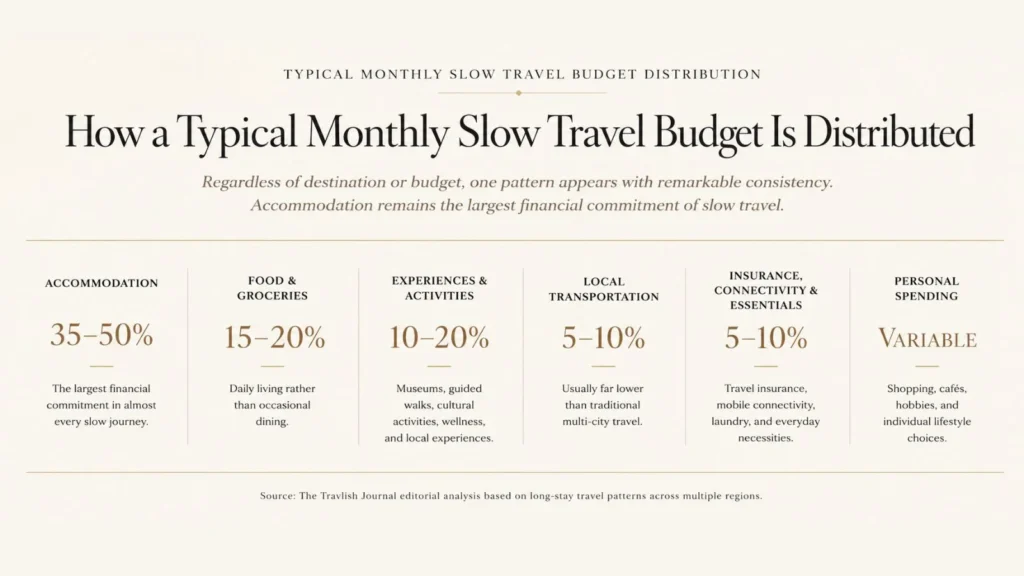
What immediately stands out is that transportation — the category most people assume dominates travel budgets — often becomes one of the smallest monthly expenses once movement slows down. Flights remain significant whenever destinations change, but within any given month, many slow travelers spend surprisingly little on getting around. Walking replaces taxis. Public transport replaces rental cars. Entire days pass without needing transportation at all because life begins unfolding within the neighborhood rather than across an itinerary.
Food follows a similar pattern. The difference is rarely between eating cheaply and eating expensively. It is between living temporarily as a visitor and living, however briefly, with ordinary routines. A traveler spending a month in Kyoto may discover the neighbourhood bakery visited each morning by local residents. Someone staying in Porto may begin recognising the weekly produce market. In Mexico City, the most memorable meal may come from a family-owned restaurant that never appears on international recommendation lists. Having both the time and the possibility to cook occasionally changes spending naturally, but more importantly, it changes the relationship with place itself. The financial outcome becomes a consequence rather than the objective.
Accommodation deserves particular attention because it quietly influences almost every other category. Whether someone chooses a thoughtfully designed boutique hotel, an extended-stay residence, a countryside villa, or a carefully selected apartment, that decision affects transportation, dining habits, daily rhythm, and even the kinds of experiences that become possible. A well-located property often reduces transport costs. A kitchen may encourage local market visits. A comfortable living space makes slower days feel rewarding rather than unproductive. The accommodation is rarely an isolated expense; it becomes the foundation upon which the entire month is built.
This is one reason long-stay pricing changes the conversation. Across many destinations, accommodation providers reward longer commitments with substantially different monthly pricing structures than nightly stays. The exact savings vary widely between regions, seasons, and property types, but the underlying principle remains consistent: the longer the relationship between guest and place, the more flexible the economics often become. That principle applies whether someone is reserving a contemporary apartment in Lisbon, a boutique guesthouse in northern Thailand, or an extended stay at a luxury property designed for longer residencies.
The destinations themselves, of course, still matter. A comfortable month across much of Southeast Asia may begin somewhere around US$1,000–2,000 for one traveler, while Southern Europe frequently settles between US$2,000–3,500, depending on location and season. Western Europe generally sits higher still, particularly in countries such as France or across Scandinavia, where accommodation alone can reshape an entire monthly budget. These figures are not recommendations, nor are they indicators of value. They simply illustrate that geography changes the size of the budget, while the financial architecture behind that budget remains surprisingly similar.
The important distinction is this: slow travel does not remove financial decisions. It simply makes those decisions more visible. Instead of spending unconsciously through constant movement, travelers begin allocating resources deliberately toward the parts of daily life that shape how a place is actually experienced. That shift, more than any individual number, is where the economics of slow travel truly begin.