





For many travelers, exhaustion no longer arrives dramatically. It appears quietly through fragmented attention, constant notifications, crowded itineraries, and the subtle feeling that modern life rarely allows the mind to fully settle. This is partly why certain islands continue to feel emotionally powerful long after larger destinations lose their impact. Not because they offer more activities, but because they reduce internal noise. Siquijor belongs to that category.
In the central Philippines, southwest of Cebu and Bohol, Siquijor remains noticeably slower than many of the country’s better-known island destinations. Ferries still arrive at a gentler rhythm, coastal roads remain relatively quiet outside local traffic, and much of the island continues to function according to daily community life rather than tourism performance. For slow travelers, this matters more than luxury infrastructure alone. The island creates the feeling that movement can soften again.

Part of Siquijor’s atmosphere comes from scale. The island is small enough to cross gradually without urgency, yet spacious enough to avoid the compressed feeling that overtourism creates elsewhere in Southeast Asia. Coconut-lined roads, tricycle rides between villages, quiet beachfront cafés, old churches, and dense tropical interiors create a landscape that encourages observation rather than consumption. Even the pacing of arrival feels different. Travelers often reach the island by ferry after passing through busier hubs like Cebu, Dumaguete, or Bohol, and the contrast becomes part of the emotional transition itself.

Visually, Siquijor does not rely on spectacle in the way some tropical destinations do. Its beauty feels more atmospheric than performative. Early mornings carry soft humidity and muted light across quiet shorelines. Afternoons slow down under heat, pushing both locals and visitors toward shaded terraces, slower meals, and longer pauses. At night, many parts of the island darken naturally once small restaurants and roadside stores close, creating an uncommon sense of spatial quiet that is becoming increasingly rare in heavily commercialized beach destinations.
The island also carries a cultural identity that separates it from the polished resort narratives often attached to tropical travel. Siquijor has long been associated in Filipino folklore with traditional healing practices, herbal medicine, spiritual rituals, and local mysticism. While modern tourism sometimes exaggerates this reputation into something theatrical, daily life on the island feels far more grounded than exoticized myths suggest. The cultural atmosphere remains tied more closely to community rhythms, fishing villages, family-run eateries, and provincial island life than to curated wellness branding.
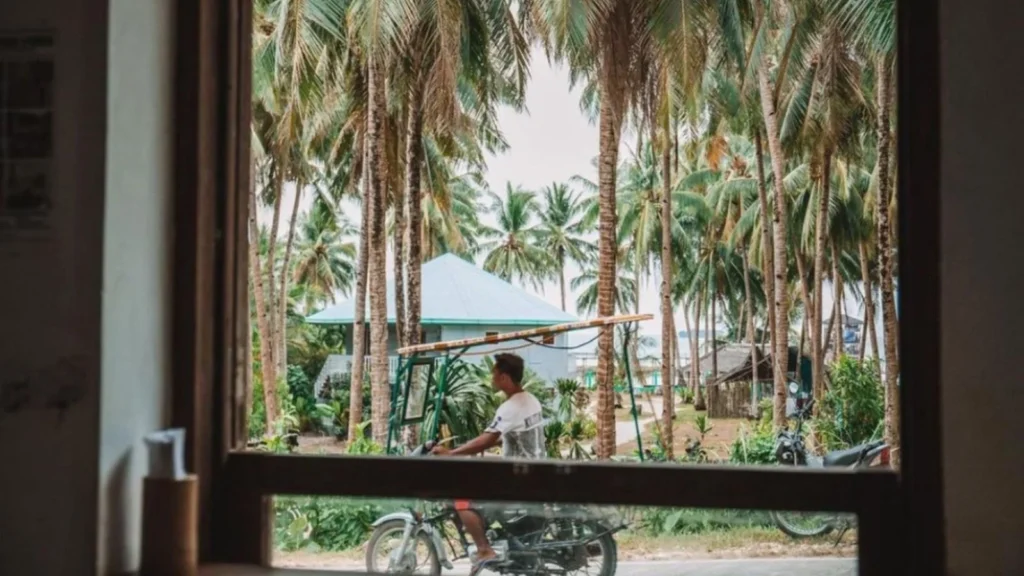
For slow travelers, the island works best when approached without an aggressive itinerary. Renting a scooter and moving gradually through the coastal loop often becomes more meaningful than trying to “complete” attractions quickly. Small moments tend to define the experience more deeply than landmarks themselves: roadside fruit stands during sudden rain, empty stretches of coastal road at dusk, conversations in quiet cafés, or the stillness of ferry ports before departure. Siquijor rewards travelers who allow space for unstructured time.
This also changes the emotional rhythm of staying there. Many visitors initially arrive expecting a short tropical stop, then extend their stay after realizing how physically calming the island feels compared to faster destinations nearby. Days begin to organize themselves around light, weather, meals, swimming, reading, and movement rather than productivity. Time stretches slightly differently on islands like this. That psychological shift is often the real luxury.

Siquijor is not ideal for travelers seeking intense nightlife, highly curated luxury shopping, or nonstop entertainment infrastructure. Its appeal depends almost entirely on emotional compatibility with slowness. Travelers who become uncomfortable with quiet, repetition, or reduced stimulation may eventually feel restless there. But for people searching for softer movement, sensory breathing room, and a less performative relationship with travel, the island offers something increasingly difficult to find in Southeast Asia: a destination that still feels emotionally unhurried.
The most compelling part of Siquijor may not be its beaches or waterfalls individually, but the way the island allows travelers to momentarily step outside accelerated living. In a period where many destinations are becoming louder, faster, and more algorithmically shaped, Siquijor still feels grounded in human pace. That alone makes it worth protecting — and worth experiencing slowly.